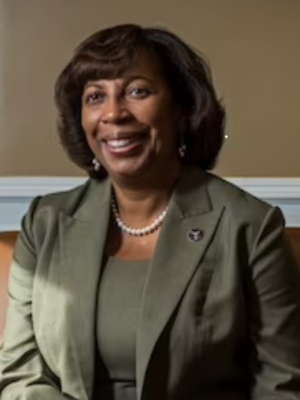
Summary of Oral History of Gennine Hagar
By Kurt J. Hamrock
“Communication is the most significant skill you have to learn as a probation officer – when to be quiet, when to listen, when to step in, when to say no, and when to let them cry.”
Gennine Hagar knows what it takes to be a good probation officer. For more than 30 years, she served as one. In 1983, she began working with the Maryland Department of Parole and Probation as a parole and probation officer, a role she held for several years. After a brief stint as a case worker with the District of Columbia Department of Corrections, she began working in the U.S. Probation Office for the District of Columbia in 1988 as a line officer. Over the years, she assumed more and more responsibility, becoming Deputy Chief Probation Officer in 2002 and then serving as Chief Probation Officer from 2007 until she retired at the end of 2016.
During her career, she watched as things changed, not only in the criminal justice system, but in the DC area as well. The probation office changed with the times, moving from typewriters with carbon paper to computers and cell phones. To Gennine, “[t]he events and changes that stand out – the AIDS epidemic and the ostracism that was associated with the disease; crack – severe addictions and long prison sentences; technology – it changed and continues to change everything; and the return to focusing on rehabilitation and treatment.”
Gennine’s upbringing in Pocomoke City, a small town on Maryland’s Delmarva Peninsula, had a lot to do with her future success. “I was in the right place at the right time, with the right people.” Surrounded by intelligent, kind, hardworking, church going family members and regularly attending a church that is over 100 years old, she graduated as salutatorian of her high school class and headed off to Towson University before beginning her criminal justice career.
As a probation officer, she learned more about her charges than what most other people knew about them. Over time, she established a rapport with them, and they confided in her. She saw herself as part law enforcement officer, part social worker. As she put it in her oral history, “I don’t recall talking to any offender who wanted to return to crime or drugs. Most of them don’t want to go back to jail – they don’t want to get back in the lifestyle. However, because of family situations, the inability to find or keep a job, pressure from their old friends, falling back into an addiction, some end up going back to prison. Overall, I would say 99.9% want to the right thing, and live a decent life, but things happen – and it doesn’t end that way.”
Ultimately serving as Chief Probation Officer for the US Probation Office in the District of Columbia was the culmination of an outstanding criminal justice career for Gennine. As she puts it,“I was fortunate to be chosen to lead a criminal justice organization. I prayed that God would help me make good decisions for my staff, the community, and for the individuals on supervision. Actually, God did above what I could ask or ever imagine. It was an awesome journey and I’m grateful for those who were sent to help me along the way.”
Gennine’s oral history is filled with memories of her years at the heart of the criminal justice system. Along the way, she learned about the people that make up that system—the defendants, the law enforcement personnel, the attorneys, and the judges. All of them had lessons for Gennine, lessons that she learned and passed along, both in words and in the way she acts towards others: “Be patient. Don’t rush to make a decision. Always tell the truth. When you can’t tell the truth, don’t say anything. Be kind and always just work to make the best decision that you can at that time.”