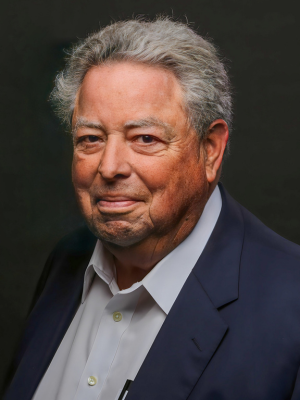
Summary of Oral History of Thomas C. Green
By Elizabeth Runyan Geise
The Oral History of Thomas C. Green provides an inside look at an almost 60-year career of one of Washington, D.C.’s preeminent white collar defense attorneys. As Green summarizes at the end of one of his oral history sessions, his career has been “a hell of a journey and quite rewarding.”
Green was born in Minneapolis in 1941. He describes his childhood in nearby St. Louis Park as “normal, safe, secure, loving.” Following his graduation from high school in 1958, he enrolled in Dartmouth College, graduating with a degree in economics in 1962. He recalls that Dartmouth, which was all male, “wasn’t far off” from the depiction in the John Belushi film, “Animal House.” He played freshman football, joined a fraternity, made numerous weekend road trips to nearby women’s colleges, and was elected by his class to give the “Sachem Oration,” at commencement. This honor required him to dress up in Native American regalia and ride to his speech on a donkey.
After Dartmouth, Green attended Yale Law School, although he considered instead a career in sports broadcasting, a skill he had developed at Dartmouth. At Yale, he made “extraordinary friends,” participated in moot court, and realized that he “liked being on my feet.”
Following the bar exam, Green had to fulfill a two-year military commitment. After basic training, the Army tried to persuade Green to join the JAG Corps. Green turned this down, and in likely retaliation, was sent to Vietnam for a year, serving in an artillery battery unit and narrowly escaping injury when a mortar hit his tent when he fortunately was not there.
In 1967, after his military service, Green moved to Washington, D.C. He did not have a job. At the U.S. Attorney’s Office, a 10-minute interview with U.S. Attorney David Bress turned into a two-hour discussion, but, at the conclusion, Bress told Green that, under Department of Justice policy, he could only offer jobs to lawyers who had had a clerkship or two years of experience. Green put his advocacy skills to work, arguing that this policy was unfair and that he had had the equivalent of a clerkship “next to an 8-inch howitzer.”
In response, Bress managed to get the policy waived, and Green began a three-year career at the U.S. Attorney’s Office that he describes as “probably the greatest time we [Green and his colleagues] ever had, as lawyers and as colleagues.” At that time, the U.S. Attorney’s Office was small, with only 16 AUSAs. There was no Superior Court at that time – just a Court of General Sessions for small cases – and about 12 federal judges. Green tried all sorts of cases and perfected his skills as a trial lawyer. He recalls many judges and fellow AUSAs from those days, including Earl Silbert, Judith Rogers, Oscar Altshuler, and Judges Holtzoff, Pratt, Gesell, Bryant, and Aubrey Robinson.
Green left the U.S. Attorney’s Office in 1970 and followed Bress to Ginsburg, Feldman & Bress. In the early 1970s, he and Bress represented Robert Mardian. Mardian had been an Assistant Attorney General under John Mitchell and was also involved with Committee to Re-elect the President (“CREEP”). Mardian testified before the Watergate (Ervin) Committee, and was a defendant in the Watergate case with Mitchell, John Ehrlich, Robert Haldeman and Kenneth Parkinson. During the trial before Judge John Sirica, Bress collapsed (he was suffering from lung cancer), and over Green’s objection and to Mardian’s dismay, the 31-year old Green became Mardian’s primary lawyer.
All the defendants but Parkinson were convicted, although Mardian’s conviction was later overturned. As Green explains, Watergate “was kind of the beginning of everything for me.” The white-collar defense bar was just forming in D.C. at that time, with the Watergate scandal, and the new (at the time) Independent Counsel Act and the Foreign Corrupt Practices Act. The white-collar defense bar was a “very small fraternity of guys” (there were very few women) who “stuck together and traded cases; we got each other into cases and we kind of commandeered the field.”
After Mardian, Green handled one high profile case after another. In the mid-1970s, he defended Harry Rodgers of Tidewater Insurance, a defendant in a corruption trial involving Marvin Mandel, a former governor of Maryland. In the 1980s, Green represented Richard Secord, a retired Army General who was involved with Oliver North and the Iran-Contra scandal. In the 1990s, Green represented Wen Ho Lee, who was accused of national security violations related to his work at Los Alamos (and who Green did not represent in his criminal case but instead in a lawsuit for a Privacy Act violation). Also in the 1990s, Green represented Tyson Foods in the independent counsel investigation involving Mike Espy, who was the Secretary of Agriculture under President Bill Clinton; Senator David Durenberger of Minnesota in an ethics proceeding; and Senator Donald Riegle of Michigan, who was involved in the “Keating 5” savings and loan scandal. In 2015-16, Green represented Dennis Hastert, former Speaker of the House of Representatives, who pled guilty to currency act violations related to hush money paid to cover up claims against Hastert of sexual abuse of minors in the 1970s. Finally, beginning in 2016, Green represented Richard Gates, who, as part of his cooperation agreement with the government, was the star witness against Paul Manafort in his 2018 trial for tax evasion and related charges arising out of Manafort’s lobbying work for a pro-Russian Ukrainian. Intermixed with these high-profile cases were many other criminal and civil cases in courts all over the United States. Green eventually joined and practiced for many years at Sidley & Austin. Over his career, he knew and worked with most of the D.C. white collar defense bar, including Edward Bennett Williams, Bill Hundley, Plato Cacheris, Jake Stein, Bob Bennett, Brendan Sullivan, Chuck Ruff, Bill Taylor, Jim Hamilton, and John Dowd.
Green also discusses his personal life, including his wonderful marriage to Pam Green, his four children, his love of classical music (including his over 10-year tenure on the Board of the National Symphony Orchestra), and his ham radio hobby.
Finally, in a coda to the Oral History, Green explains his formation in 2025, with several other retired lawyers, of the Washington Litigation Group. This law firm, which is a 501(c)(3) organization and supported by donations, has, as its mission, to “promote the rule of law” and to “find cases that will accomplish that” during the second Trump Administration.
All and all, Green’s oral history is fascinating recounting of white-collar representation and some of the most high-profile cases in D.C. in the last sixty years.